- Force Multipliers
- Posts
- The Paradox of Rest: Why Doing Less Often Produces More
The Paradox of Rest: Why Doing Less Often Produces More
Lessons from neuroscience and elite performance coaching on why stillness multiplies output.

Regina Gerbeaux
January 04, 2026 • Reading Time: 8 minutes
Back in college, I had a physical planner addiction.
I loved my Erin Condren planner, which probably weighed about five pounds. I loved color coding it, writing in it, and most importantly, decorating it with stickers.
But maintaining it was a full time job, despite my two work study jobs, working full time as a piano teacher, and going to school full time at USC.
One day, I realized I didn't need the planner anymore.
It occurred to me that I was making life more difficult for myself: though I derived joy from decorating my planner, I wasn't actually using it to keep afloat. I always used my Google Calendar - I have, and always will be, a color-coding-use-ten-different-calendars-to-keep-everything-separated-and-organized-on-G-Cal kind of operator.
The planner created the illusion of productivity. I wasted more time than I actually got more productive. And while it was fun, I no longer had the time to do it.
This realization became one of my first lessons in what neuroscience now confirms: your brain isn't designed to be "on" all the time.
What Your Brain Does When You "Rest"
Most leaders think rest is the absence of work. But neuroscience tells us something different:
When you stop focusing on a task, your brain doesn't shut off. It switches on what researchers call the Default Mode Network (DMN).
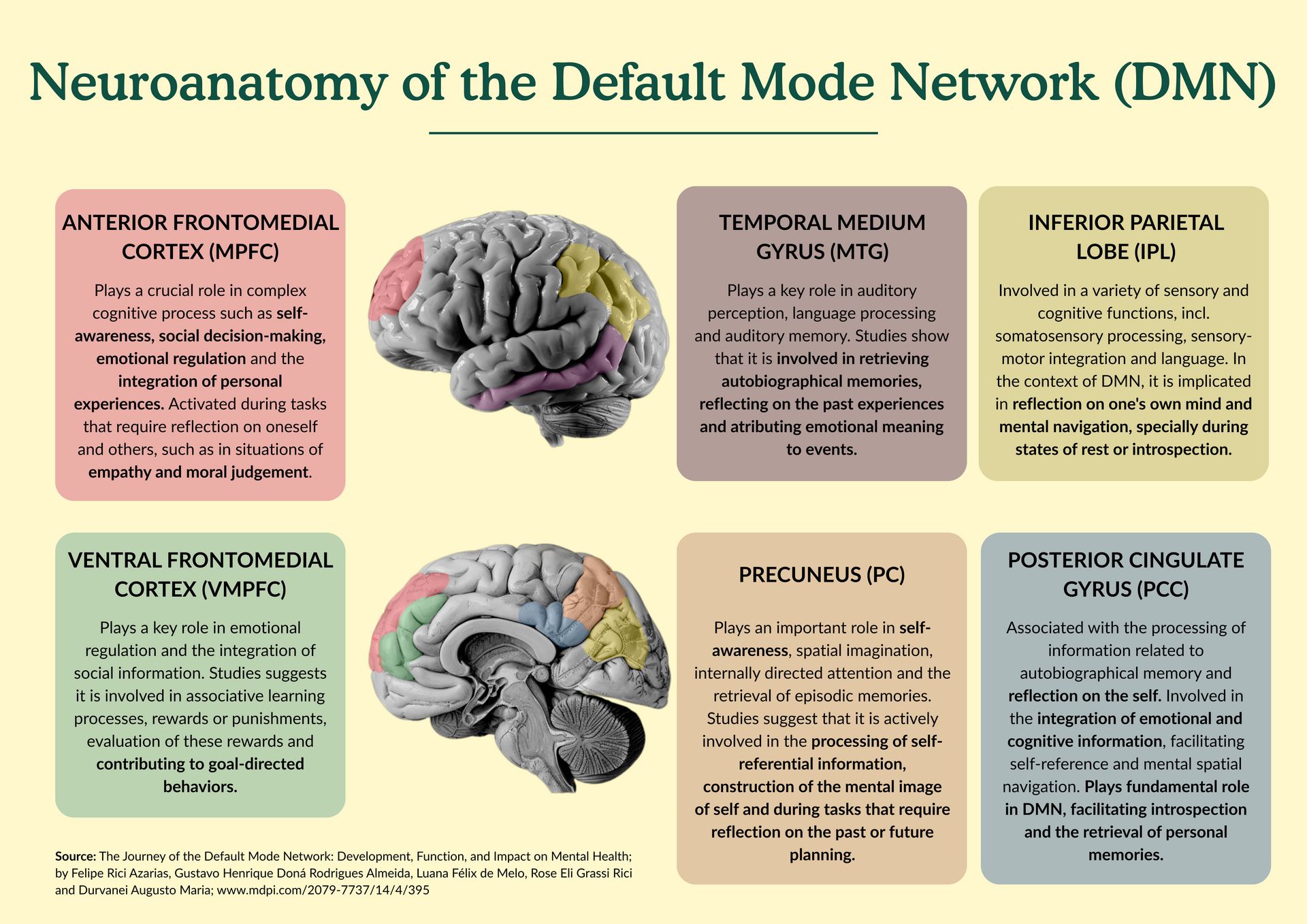
The DMN was discovered by accident. Scientists studying brain activity expected to see certain regions "turn off" during rest periods. Instead, they found increased activity in specific areas when people weren't focused on external tasks.
What the DMN actually does:
Consolidates memories and integrates new learning
Enables creative problem-solving and "aha" moments
Processes emotional experiences and builds self-awareness
Plans for the future and makes connections across different ideas
👉 Research shows that people who devote the longest time to studying aren't necessarily the most efficient. High performers manage their time well, take breaks, and complete necessary tasks while maintaining energy. The brain needs to switch between focused attention and rest to enable information integration and sorting.
Meanwhile, continuous cognitive effort leads to what researchers call "brain strike." When fatigued, people become less willing to exert effort for reward. They prefer low-effort, low-reward options compared to when they're rested.
That’s why you love scrolling Tiktok and YouTube after a long, exhausting day of back-to-back meetings, instead of working on your Top Goal, or going out with friends. It’s not because you don’t want to get deep work done… it’s because your brain is literally incapable of exerting any more effort.
Think about it: when was the last time you had a real breakthrough insight while grinding away for hours at your desk?
Probably never. Those moments happen in the shower, on a walk, or right before you fall asleep.
Your brain needs the DMN to do its best work.
I coached a CEO who was brilliant. He had all sorts of fun, interesting ideas. Part of his charm was being a pretty cosmopolitan guy: he had many different interests, liked reading a lot of different information, and connecting the dots across multiple subjects that piqued his interest.
The problem was he had a new idea every day.
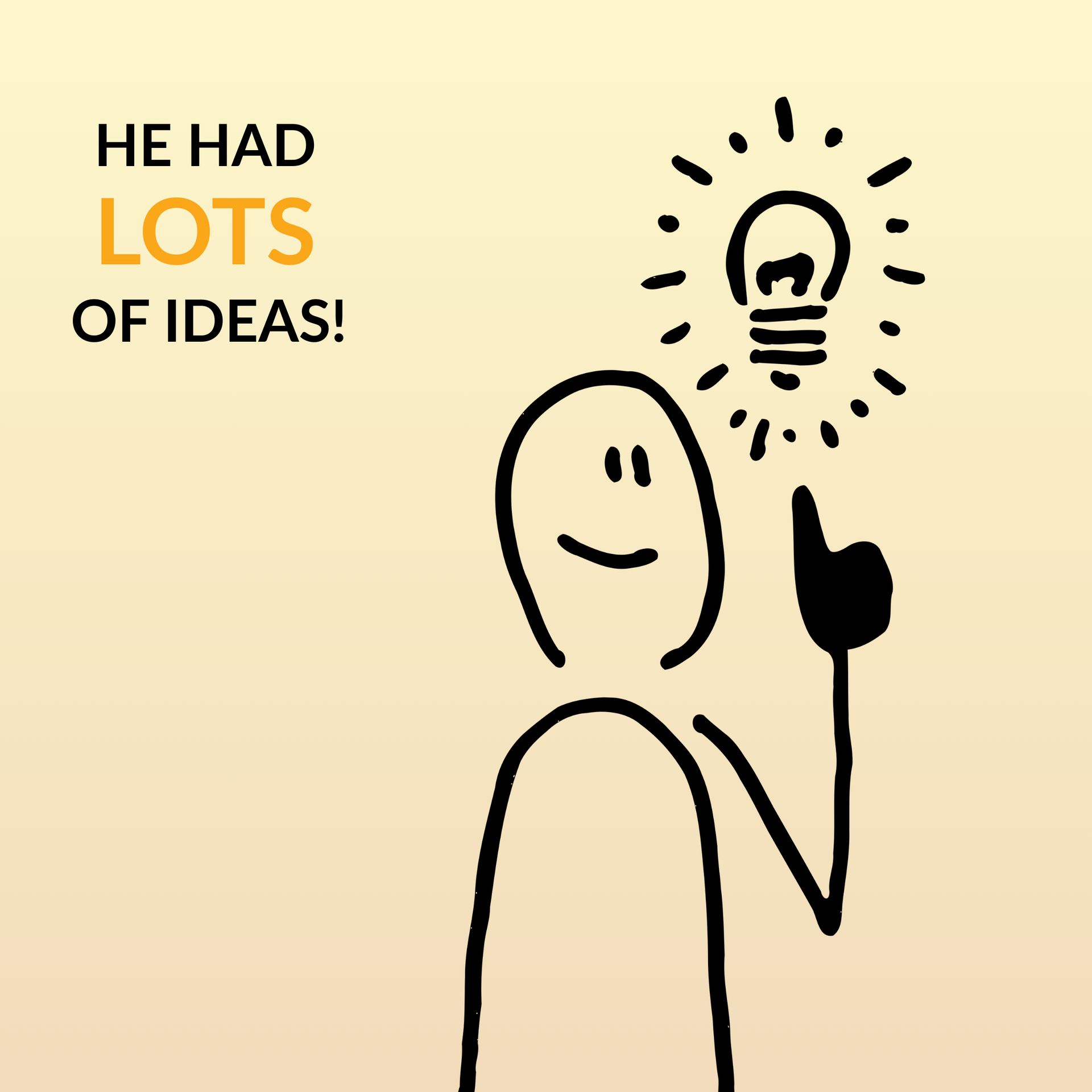
That exhausted his operational team, who tried their hardest to stay totally focused on the mission. He had "drive-by" ideas: he threw ideas in Slack, not realizing how powerful his words were, and that distracted the whole team and detracted from their already-ongoing initiatives.
💡 Helpful Hint: This CEO found that writing the ideas down in a "someday/maybe" Notion page helped him feel like he was preserving his "genius brilliant idea" while staying focused.
He laughed later on realizing that 99% of the stuff that made it to his someday/maybe page never ended up getting actioned on, because it wasn't worth the time.
But he did like that he had the list to reference during quarterly planning to methodically and calculatedly bake it into the future quarter goals if it was really part of the 1% of ideas that would move the needle forward. His Chief of Staff helped him stay accountable and was good about reminding him to stay focused and not get distracted.
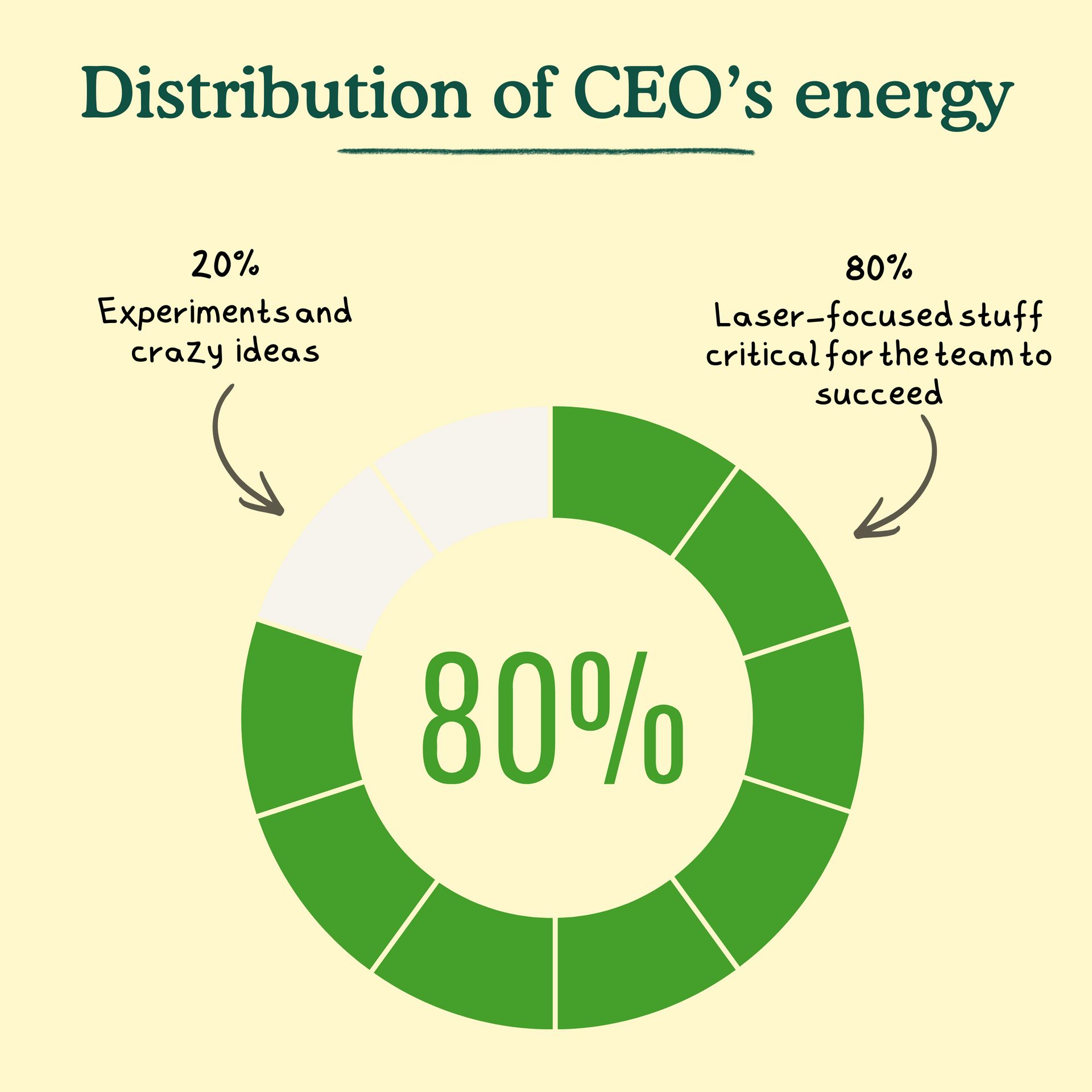
In our coaching, we had to work hard on getting him to adopt the 80-20 principle: 80% of your overall energy goes towards the laser-focused stuff that you know is critical for the team to succeed; 20% goes to experiments and crazy ideas. The same thing is true for resource allocation in time and personnel.
Doing lots of stuff is often a fear-based reaction. CEOs feel like they have control this way.
The way writing in my planner produced the illusion of control over my life, writing endless to-do lists, choosing five different note-taking devices, and tackling too many initiatives usually creates the same illusion of control.
Decision fatigue is real and measurable. When you're cognitively fatigued, you're more likely to forgo higher rewards that require more effort. The brain regions responsible for effort valuation show altered activity after repeated mental exertion.
Quality Over Quantity, Always
I realized that "less is more" is a good first principles rule when I zoomed out and thought about the moments I achieved all my goals in life. It was because I ruthlessly prioritized (not everything can be a priority), and focusing allowed me to achieve way more with better results than being spread thin.
Here are some examples below of when quality > quantity:
Eating nutrient dense foods can mean a smaller quantity, but with better energy and macros. That's why you feel still hungry after eating lots of junk. Quality over quantity.
Saying "no" to activities allows you to focus on the 1-2 activities that you genuinely love doing, and you can get better at them. Quality over quantity.
Having 1-2 close friends is better than 50 OK-ish friends. Quality over quantity.
There are very few moments where doing more actually results in a better quality of life. You just have less bandwidth over time to contribute to the things you're doing if you have more of them.
The same thing is true for companies. But for some reason, leaders miss this point. I see CEOs constantly push a multitude of experiments to run long-term. I think it's good to run lots of experiments, as long as you kill them just as quickly.
Perhaps the biggest critical feedback I hear a lot of my CEOs get is that they're not focused enough; they get shiny object syndrome too easily; they're too easily distracted by what other people are doing and not focused enough on the 2-3 things that would actually move the needle forward.
At the time of this writing, I am the mother of an almost 5 month old daughter, Baobao. These earliest years are the most precious and I'll never get them back. Parenting is one of the best ways to realize how finite your time is, and how ruthlessly you have to prioritize.
Things I say no to with zero apologies:
Building a course/operational community for now (this one is hard to say no to because I WANT TO, but I just don't have the bandwidth to commit the full energy I want to commit to it. I believe in doing things right, not rushed or half-baked)
Virtual coffees outside of my "virtual coffee hour" (I want to still meet people, but I want it to be a full bodied yes and during time I dedicate specifically to it)
Filling out forms (delegate to an assistant)
Posting regularly on social media (I write, then delegate posting to an assistant)
What I gained in the process:
Dedicated time with Baobao and Lucas to love on them (quality time, relationships)
Dedicated time for my coachees (relationships, work, income)
Dedicated time to write this newsletter (audience building, clarity of thought, enjoyment)
Dedicated time to read (curiosity, staying informed)
Dedicated time for my friends (quality time, relationships)
Dedicated time for self-care (filling my own cup to better love on everyone else)
Those are the things that move the needle forward and positively add to my quality of life.
I think it's almost entirely universal for every leader to audit how they're spending their time and what one thing they can cut out in order to focus a little better on stuff that really matters. This is true not only in work, but also in personal life. It's why I'm a big believer in having not only an assistant to help you at work, but at some point when you're making enough money, it helps to also hire a personal assistant to help you with scheduling appointments, hiring cleaners/dog walkers/doing research on daycares and nannies, running errands, and so much more.
Is it a privilege? Yes. Would everyone on earth hire a personal assistant if they could afford one to help reclaim valuable time? Also yes.
The Playbook on Doing Less to Achieve More
1. Define Your Top Three Goals 🔝
What three things do you need to accomplish by end of quarter? Pick two business, and one personal.
This isn't aspirational. This is the stuff that, if you accomplish nothing else, would make this quarter a success.
How to implement:
Encourage everyone else on your team to do this too
Create your "someday/maybe" list for everything else (capture it so you don't lose it, but don't let it distract you)
Get a Chief of Staff or Executive Assistant to hold you accountable to top goal time
Block it in your calendar as "busy - please no meetings" every single morning. I do this for writing (I'm currently writing this newsletter in my dedicated top goal timeslot. I have not yet checked email, Slack, or my phone.)
2. Craft Your Narrative (And Stick To It) 📝
What three points do you want everyone on your team to remember you're marching towards?
Three is all they can remember and implement effectively.
My suggestion: pick a structure like this:
Here's where we're at today
Here's the valuable opportunity we have to capture market share and help our customers (make this charismatic!)
Here's what we need to do by [deadline] in order to have [exciting milestone, like fundraising, securing more customers, growing exponentially, etc.]
Repeat this narrative everywhere. All hands meetings. One-on-ones. Slack updates. Make it so clear that your team can recite it in their sleep.
3. Build Your "No" Protocol 👎️
Saying no is a skill you can systematize.
Save response snippets. I have snippets saved into Alfred so all I have to do is type "no to coffee", "no to meeting", "no to conference", and it will spit out a pre-written response. Having snippets saved allows you to say no faster and better. Hiring an EA to help you draft those responses is even better.
Immediate no vs. let me think about it:
Immediate no = it's not a full-bodied yes
Let me think about it = you could be excited and interested about it, but you need to weigh it against your current priorities
When it's "let me think," you have to be honest with yourself: will it actually result in a tangible goal moving forward? And what are you saying NO to in the process of saying YES to this? Identify the hidden cost.
Handling drive-by ideas (yours or others'):
Teach your team to ask you: "Is this drive-by or is this a real initiative with a real sense of urgency, and if it's the latter, what are we deprioritizing in order to do this?"
This one question will save you countless wasted hours on shiny objects.
4. Weekly Reset Ritual 🧘
Pick a time (Friday afternoon or Sunday evening) and make it non-negotiable.
During your weekly reset:
Review what actually moved the needle vs. what was just activity
Clear out the noise that accumulated during the week
Recalibrate focus for the coming week
Revisit your top three goals and assess progress
This is when you process everything your DMN has been working on in the background. You'll be amazed at how many insights emerge when you give yourself permission to step back.
5. Quarterly Energy Audit 👀
Once a quarter, do an honest assessment of where your time and energy actually go.
Elite athletes know that recovery isn't optional. An adequate balance between stress (training and competition load, other life demands) and recovery is essential to achieve continuous high-level performance. The same principle applies to leaders.
Questions to ask yourself:
When do I have peak cognitive energy? Am I protecting those hours for my top goals?
What activities drain me that don't move the needle?
What can I delegate, automate, or eliminate entirely?
Am I spending time in high-impact activities, or just staying busy?
Be ruthless in your assessment. Your brain's capacity for sustained focus is finite and recoverable. One state of fatigue increases after effort but is recoverable by rest. Another gradually increases with work and isn't immediately recoverable by short breaks.
Manage your energy like the limited resource it is.
Conclusion
Your brain does some of its most important work when you're not working.
The illusion of productivity keeps leaders trapped in constant activity, but research consistently shows that the Default Mode Network activates during rest to consolidate memories, generate creative insights, and process emotional experiences.
Doing less isn't about being lazy. It's about being strategic enough to know that three focused priorities will always beat thirty scattered ones.
Until next time,

📍 Resources Mentioned:
Was this newsletter forwarded to you? Are you here for the first time? If so, remember to subscribe below…
Want more operational content?
Check out Coaching Founder for downloadable Notion templates and write-ups on how to level up your execs, your teams, and yourself.
About Regina Gerbeaux
 | Regina Gerbeaux was the first Chief of Staff to an executive coach who worked with Silicon Valley’s most successful entrepreneurs, including Brian Armstrong (Coinbase), Naval Ravikant (AngelList), Sam Altman (OpenAI / Y Combinator), and Alexandr Wang (Scale). |
Shortly after her role as Chief of Staff, then COO, she opened her own coaching practice, Coaching Founder, and has worked with outrageously talented operators on teams like Delphi AI, dYdX, Astronomer, Fanatics Live, and many more companies backed by funds like Sequoia and Andreessen Horowitz.
Her open-sourced write-ups on Operational Excellence and how to run a scaling company can be found here and her templates can be found here.
She lives in the Pacific Northwest with her partner, daughter, and dog, and can be found frequenting 6:00AM Orangetheory classes or hiking trails nearby.
Reply