- Force Multipliers
- Posts
- The Executive Sabbath: Why the Smartest Leaders Schedule Stillness
The Executive Sabbath: Why the Smartest Leaders Schedule Stillness
Learning from top operators who carve out “thinking days” to preserve creativity and judgment.

Regina Gerbeaux
December 21, 2025 • Reading Time: 7 minutes
Here’s a personal story:
It was late August 2023, and I was running on fumes ready to die from stress.
I was building a startup while running my coaching business. Cofounder troubles were eating me alive. My personal life felt like it was crumbling. And I was doing deep therapy work that led to a C-PTSD diagnosis related to violent and disturbing childhood trauma.
I felt out of control.
Normally, my default response to feeling out of control would’ve been to do MORE. More meetings. More strategy sessions. More emails at 11 PM. MORE everything.
But this time, something was different.
Maybe it was my Daily Calm practice finally sinking in. Maybe it was pure exhaustion. Whatever it was, I knew that doing more was the wrong answer.
I knew I had to stop.
So I booked a yurt in the middle of nowhere. End of summer, when everyone else had cleared out. Just me, my burner phone, and acres of hiking trails and sand dunes down to the Columbia River.


No one had my number. No internet except for Maps. A week of total silence.
The first night was hell. Night crawlers in the yurt. No cushy hotel with chocolate on my pillow. What I had was the company of discomfort and a racing mind.
But I lit a candle and journaled by the fire.
Over the next few days, something shifted. My mind slowed down. I started feeling human again. I meditated daily, hiked down to put my feet in the Columbia River, sat under the stars without light pollution, and read two books.
The point wasn't to be productive. It was to be present.
And here's what I discovered: my clearest thinking happened when I slowed down, not when I sped up.
When I got bored enough to get creative. When I had time to ask the big questions. Why was I here? What did I actually want? What was God trying to tell me about my life?
I went back home and ended my cofounding relationship. Not out of anger or impulse, but from clarity. I realized I'd FOMO'd into a lot of decisions I wasn't proud of. Decisions I wouldn't have made from a “possibilist” mindset instead of a scarcity mindset.
The ending wasn't amicable. But I felt calmer than I'd ever been about how it unfolded. I could see clearly what was worth fighting for and what was best left alone.
That trip taught me something I couldn't unlearn: I didn't need a desert yurt to access stillness. It was always available, even at home.
Now I take restoration weeks at least once a quarter. No coachees. No investors. No startup founders. I spend a week focusing on touching grass (literally), standing in the rain, sleeping as long as I want.
A week might feel like forever. But it's a small price to pay for clarity and calm.
What I See When Operators Skip Stillness
Before that trip, I was a mess. Quick to anger. Everyone around me seemed stupid. I was sleeping like shit and eating like shit. The only thing I had going for me was consistent workouts, but even that couldn't outrun my mental state.
Meeting with VCs felt like a barrage of "not good enough." Every pitch activated my deepest shame pathways. I was insecure, reactive, and frankly not someone I'd want to work with.
In the executives and founders I coach who don't have any stillness practice, I see this pattern repeat:
They start using drugs to cope. They spiral into sleep debt. Addictive behaviors creep in. They isolate from people who actually love them.
They treat their teams with disrespect. Eventually, their best performers leave.
People become afraid to tell them the truth because they're terrified of being called dumb or told they suck (sound familiar? Check out this piece on becoming a dictator).
Then they're left handling their regret (which I've written about here).
The problem isn't that they're bad leaders. The problem is they're running on empty.
The Playbook: Building Your Practice of Stillness
Look, I'm not going to tell you to quit your job and find a yurt. That's not practical, and honestly, it's not necessary.
What IS necessary is understanding that stillness isn't optional for good leadership. It's foundational.
The practices below pull from Zen Buddhism, existentialism, mindfulness, and teachers like Thich Nhat Hanh. But they're translated for operators who live in the real world, not monks in monasteries.
1. Start with micro-stillness (5-10 minutes daily) 🧘
You don't need an hour of meditation to benefit from stillness. You need consistency.
Start here:
Morning pages (3 pages of stream-of-consciousness writing before you check your phone)
Walking meditation (Walk slowly, paying attention to each step. Thich Nhat Hanh taught: "Walk as if you are kissing the Earth with your feet.")
Conscious breathing (Box breathing: inhale for 4, hold for 4, exhale for 4, hold for 4)
The goal isn't to "clear your mind." That's impossible and not even the point. The goal is to notice your thoughts without getting swept away by them.
In Zen Buddhism, this is called "just sitting" or zazen. You're not trying to achieve anything. You're just being with what is.
2. Create buffer time between meetings ⏯️
This sounds simple, but most operators pack their calendars back-to-back.
Try this: Add 10-15 minutes of "nothing time" between meetings.
Use it to:
Stare out the window
Take a walk around the block
Sit in silence
Write down what you're noticing
Existentialist philosopher Martin Heidegger called this "dwelling." Not doing, just dwelling. It's in this space that genuine insight emerges.
One of my coachees, a VP of Ops at a Series B company, started doing this and realized she was making better decisions in afternoon meetings. Why? Because she wasn't carrying the emotional residue from her morning into the rest of her day.
3. Institute a weekly "thinking day" 💡
Bill Gates is famous for his "Think Weeks." Twice a year, he'd disappear to a cabin with nothing but books and time to think.
You don't need a week. Start with four hours.
Block it on your calendar. Protect it like your most important investor meeting.
During this time:
No email
No Slack
No "quick questions"
Bring only yourself, a notebook, and whatever big questions you're wrestling with
In mindfulness practice, this is called "deep looking." You're giving yourself permission to look deeply at what's actually happening, instead of just reacting to surface-level urgency.
👉️ One framework I love: Ask yourself three questions during your thinking time:
1. What am I avoiding?
2. What decision am I delaying because I'm afraid?
3. If I knew I couldn't fail, what would I do differently?
4. Practice "beginner's mind" in familiar situations
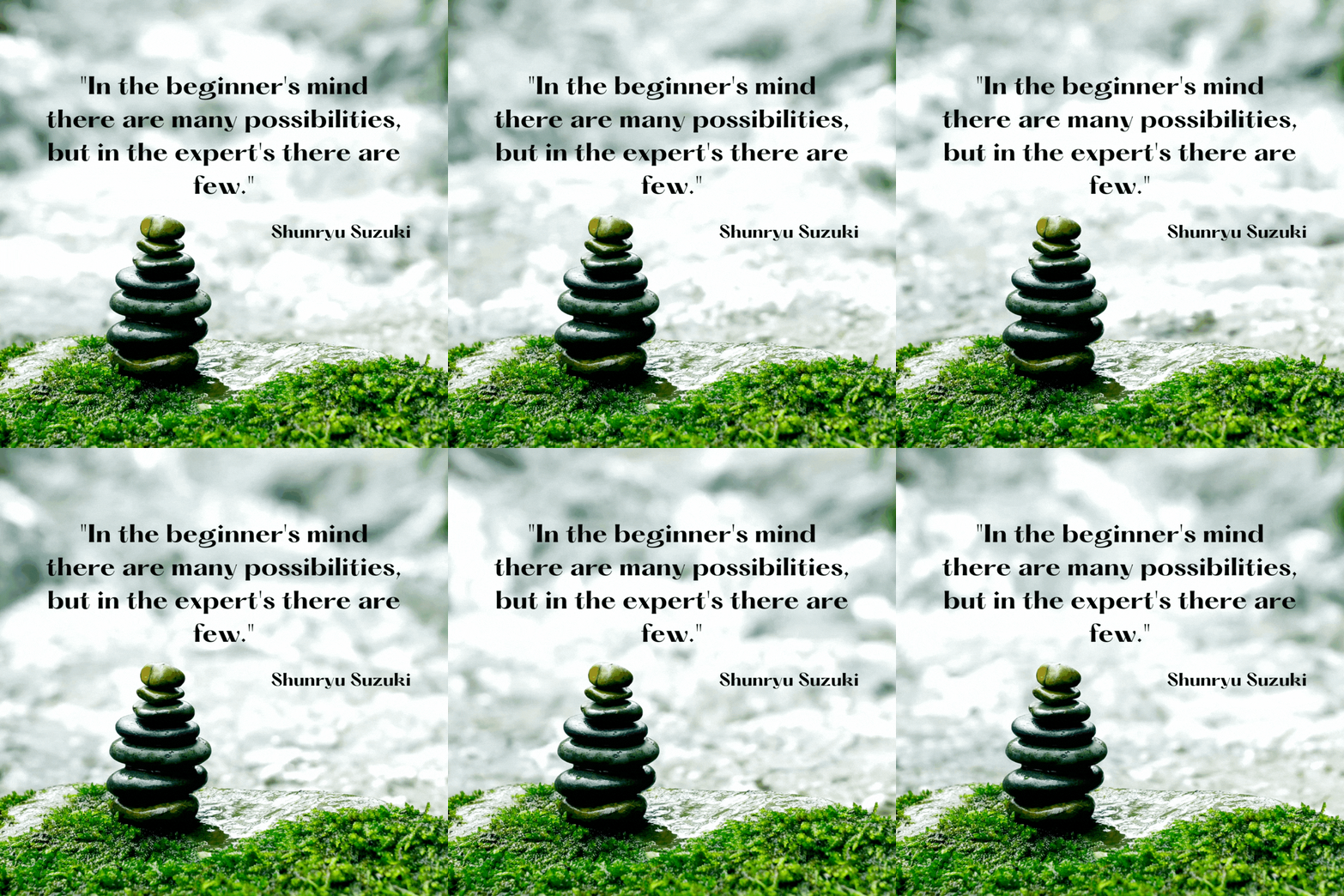
Zen teacher Shunryu Suzuki wrote: "In the beginner's mind there are many possibilities, but in the expert's there are few."
As operators, we get good at pattern-matching. This is useful, but it also makes us rigid.
👉️ Try this: In your next leadership team meeting, pretend you're hearing everything for the first time.
Don't jump to solutions. Don't mentally draft your response while someone else is talking. Just listen as if you know nothing.
This single practice will reveal assumptions you didn't know you were making.
5. Build in quarterly restoration weeks 🗓️
Here's where I'll push you a bit: One week per quarter of deep restoration is not negotiable if you want to sustain high performance.
This doesn't mean a vacation where you're still checking Slack. This means actual disconnection.
During my restoration weeks now, I:
Turn off notifications
Don't talk to any coachees, investors, or founders
Spend time in nature (even if that's just a local park)
Sleep as much as my body wants
Read for pleasure, not productivity
Let myself get bored
Boredom is where creativity lives. When you're constantly stimulated, you never access the deeper layers of thinking.
The existentialists understood this: Sartre wrote about "nausea," that uncomfortable feeling of confronting existence without distraction. It's in that discomfort that you find what actually matters to you.
6. Create rituals that mark the transition into stillness 🔔
Thich Nhat Hanh teaches about "bell of mindfulness," a sound that reminds you to return to the present moment.
You can create your own version:
Light a candle when you sit down to journal
Make a specific cup of tea before your thinking time
Take three deep breaths before you walk into your home after work
These rituals signal to your nervous system: "We're shifting now. We're moving from doing to being."
7. Notice without judgment ☺️
This is the hardest one.
When you practice stillness, you'll notice all kinds of uncomfortable things. Anxiety. Anger. Shame. The urge to check your phone.
Don't try to fix these feelings. Just notice them.
In mindfulness, this is called "non-attachment." You're not trying to make anything go away. You're just observing it, like watching clouds pass across the sky.
👉️ One practice that helps: Name what you're feeling. "I'm noticing anxiety." "I'm noticing the urge to be productive." "I'm noticing judgment toward myself."
Naming creates distance. Distance creates choice.
What Stillness Actually Gives You
Let me be clear about what stillness is NOT:
It's not lazy. It's not unproductive. It's not "woo-woo" or indulgent.
Stillness is strategic.
When you practice stillness regularly, you get:
Clearer judgment. You stop making reactive decisions based on fear, FOMO, or other people's urgency.
Better pattern recognition. You can see what's actually happening instead of what you're afraid is happening.
Increased capacity. Ironically, slowing down creates more energy for what actually matters.
Stronger relationships. When you're not running on empty, you show up as someone people actually want to work with.
Preserved creativity. Your best ideas don't come from grinding. They come from the space between the grinding.
The smartest operators I know aren't the ones working 80-hour weeks. They're the ones who know when to push and when to pause.
They've learned what I learned in that desert yurt: Your clearest thinking happens when you slow down, not when you speed up.
So let me ask you: When's the last time you gave yourself permission to be still?
Not productive still. Not "I'm meditating to optimize my performance" still.
Just... still.
If you can't remember, that's your answer.
Start small. Five minutes tomorrow morning. A ten-minute buffer between meetings. A thinking walk this weekend.
You don't need a desert yurt to access this. You only need to decide that your clarity is worth protecting.
Because here's what I know for sure:
The best decisions you'll make as a leader won't come from the next strategy meeting. They'll come from the quiet moments when you finally give yourself space to think.
Until next time,

P.S. What did you think of this framework? Hit reply and let me know which part resonated most with you. I read every response.
📌 Resources mentioned:
Stop Being a Dictator-in-Chief | Force Multipliers, Issue 32
How Great Leaders Handle Regret | Force Multipliers, Issue 23
The Artist's Way | Julia Cameron
Nausea | Jean-Paul Sartre
Nonattachment Mediates the Relationship Between Mindfulness and Psychological Well-Being, Subjective Well-Being, and Depression, Anxiety and Stress | Whitehead, Richard & Bates, Glen & Elphinstone, Brad & Yang, Yan & Murray, Greg. (2019). Journal of Happiness Studies.
And if you’re reading this - you're already ahead.
Because you know where to find the stuff that’s actually good. Like my templates and resources, and this newsletter.
Was this newsletter forwarded to you? Are you here for the first time? If so, remember to subscribe below…
Want more operational content?
Check out Coaching Founder for over a dozen downloadable Notion templates to use at your company, and tons of write-ups on how to level up your execs, your teams, and yourself.
About Regina Gerbeaux
 | Regina Gerbeaux was the first Chief of Staff to an executive coach who worked with Silicon Valley’s most successful entrepreneurs, including Brian Armstrong (Coinbase), Naval Ravikant (AngelList), Sam Altman (OpenAI / Y Combinator), and Alexandr Wang (Scale). |
Shortly after her role as Chief of Staff, then COO, she opened her own coaching practice, Coaching Founder, and has worked with outrageously talented operators on teams like Delphi AI, dYdX, Astronomer, Fanatics Live, and many more companies backed by funds like Sequoia and Andreessen Horowitz.
Her open-sourced write-ups on Operational Excellence and how to run a scaling company can be found here and her templates can be found here.
She lives in the Pacific Northwest with her partner, daughter, and dog, and can be found frequenting 6:00AM Orangetheory classes or hiking trails nearby.
Reply